

Where Folk Meets Techno: Designing the Self Across Rooms
GenAI Design Curation

A room-by-room essay on multiplicity—how music, fashion, and space become a daily practice for identity.
You don’t have one self. You have a closet.
It started as a catch-up: two people talking like they always do—warm, reflective, a little energized by the simple relief of being witnessed. But the conversation kept returning to the same quiet question:
what if identity is something you can design—room by room—without forcing it into a single look, a single sound, a single story?
In this story, multiplicity means the many legitimate versions of you that show up in different spaces—each real, each coherent, none requiring an apology.
The Bedroom Cocoon: Grounding Before the Night
There’s a certain kind of honesty that only happens when the world is smaller—when you’re tucked into a soft room, wrapped in blankets, speaking from the part of life that isn’t performative. That’s where this interview began: daily-life grounding that slowly turned into philosophy. The tone stayed gentle, but the implication grew bigger: creative practice isn’t something you “become,” it’s something you return to.
This is where the first self lives—the one that needs steadiness. The one that uses music and movement not as decoration, but as emotional regulation. When words fail, you find another language: a dance floor as a secondary home, musical theater as a vessel for feelings you can’t name yet. That’s not escapism. That’s craft as care.
The Blue Room: Presence Without a Body
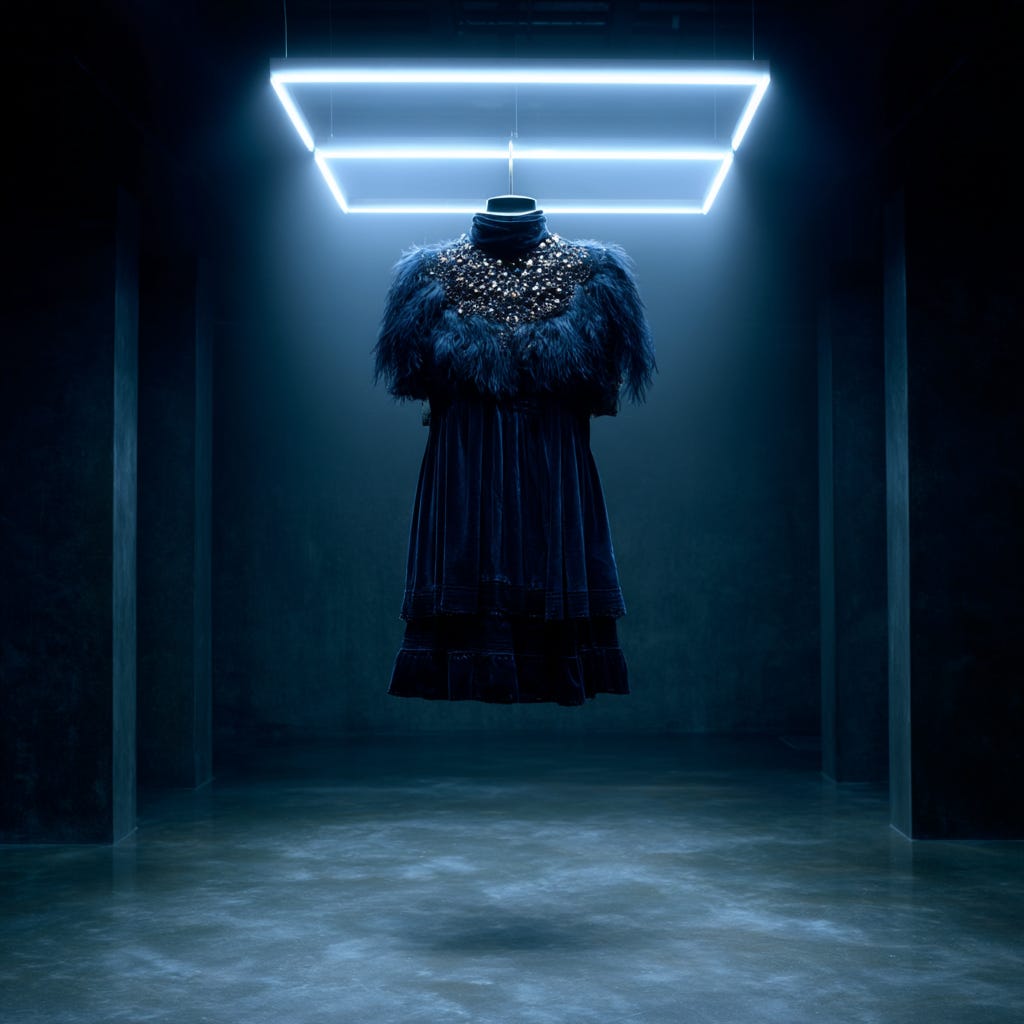
Now imagine a midnight-blue room, lit like a held breath. In the center: a short velvet dress floating as if gravity is optional—fur collar, rhinestones catching minimal light. No body. Just presence.
I keep coming back to this frame because it’s a perfect metaphor for multiplicity: a self, waiting. Not “the” self. A mode.
This is where folk meets techno—not as a genre mashup, but as a design principle. Folk warmth: hand-feel, softness, story stitched into material. Techno focus: precision, repetition, the clean pulse that organizes a room. Together, they don’t cancel each other. They make a silhouette that says: I can be tender and exact. I can be intimate and engineered.
And the best part? The dress is not a costume. It’s a choice—one of many. The closet isn’t confusion. It’s capacity—a wardrobe of modes you can actually live inside.
The Leather-Forward Bar: Codes, Texture, and Armor
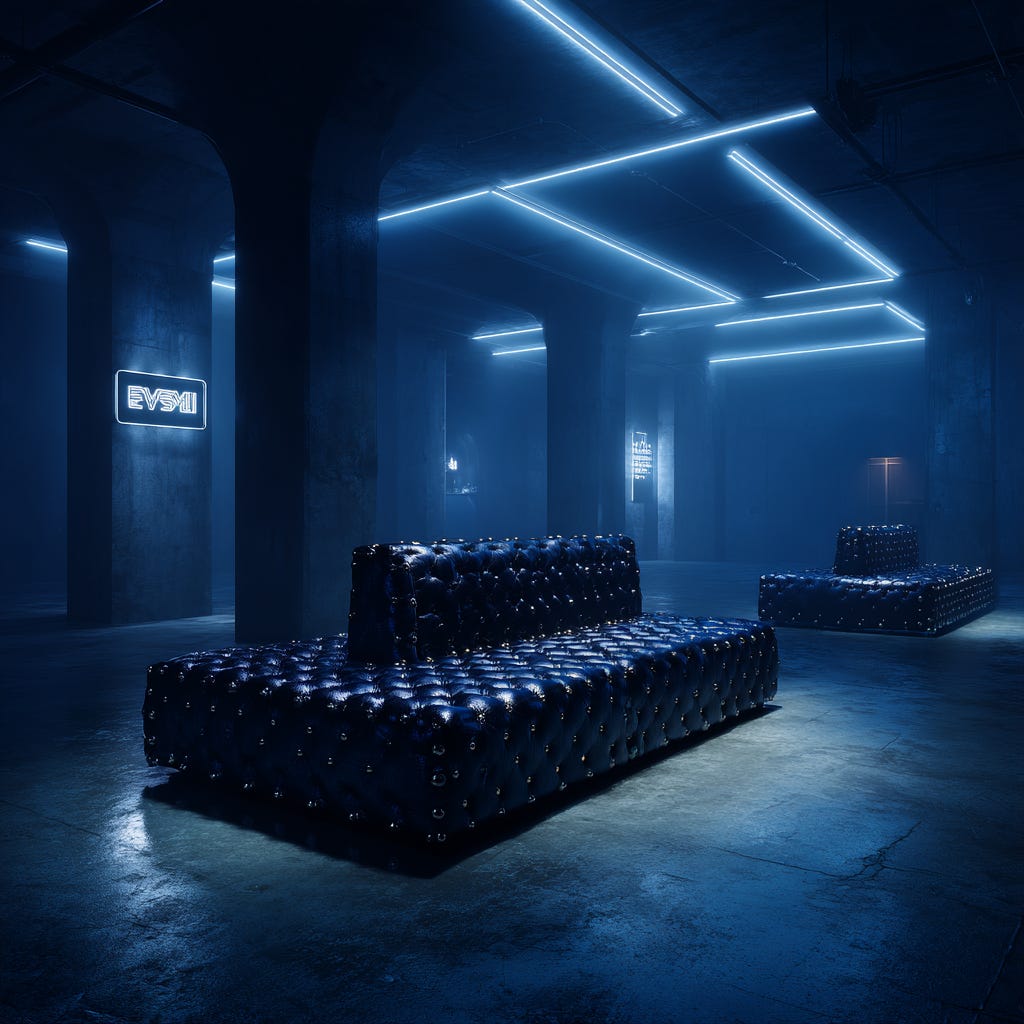
Walk into a leather-forward queer dance bar and you can smell the room before you understand it: that new leather edge, the crispness of black and white, mesh against skin, silver stitching, studs and spikes like punctuation. This is a space with codes—and codes can be beautiful when you treat them like typography: a shared language, a signal, a way to say “I’m here.”
But here’s what the conversation made clear: a coded room doesn’t have to reduce you. It can reveal a self you needed. One of the “hundred boxes” humans carry. Same person, different clothes in the closet.
There’s a confidence that shows up in this room that isn’t loud. It’s architectural. It’s in the decision to wear something that holds shape. It’s in the way a look can say “don’t mistake my softness for uncertainty.”
The Size-Inclusive Queer Club: Fur, Lace, and Permission

This room teaches a different self: playful authority. The one who remixes tradition instead of obeying it. The one who can take a classic club piece and reinterpret it—crochet lace where you’d expect something harsh, softness where you’d expect armor.
I think this is why fashion matters in the same breath as music: both are daily-accessible art forms. You don’t need a museum ticket to make a choice about texture, rhythm, silhouette, or sound. You can practice multiplicity every day—through what you wear, what you listen to, and where you let your body land.
The Techno Basement: Unforced Confidence and the Collective Journey

This is the room where the lights narrow and the beat becomes a corridor. Techno focus. Circuit pulse. The steady rhythm that doesn’t beg for attention—it just keeps telling the truth.
Presence Has a Sound
One of the strongest ideas from the conversation was this: confidence reads as unforced. The song feels powerful because it isn’t straining. It stays within range. It takes you through a collective journey without needing to prove itself.
That’s a lesson you can apply beyond music. Unforced confidence is what happens when a self fits the room—when your choices aren’t trying to convince anyone. They’re just aligned.
This is also where “where folk meets techno” becomes a lived feeling: warmth inside structure. Intimacy inside repetition. A whispered warehouse party energy—music-first, connection in the side space—paired with the focused austerity of a basement. Same heartbeat underneath. Different rooms. Different selves. Still you.
A brief note the conversation held with care: energy stewardship. Sometimes multiplicity includes the “self who audits.” The one who notices brain chemistry, timing, and the aftertaste of a night out. Not as moralizing—just as design. Boundaries can be part of the look, too.
The Closet: A Repeatable Ritual for Designing the Self Across Rooms
Here’s the operational insight I want to keep: creativity becomes sustainable when you give it a limit—and permission for messiness. Timeboxed creation is not a compromise; it’s a doorway. Go into the studio for an hour. Let it be bad or good. The point is the return.
If you want to practice designing the self across rooms—and build your own wardrobe of modes—try this small ritual (and keep it privacy-first):
Pick one recent moment that refused to leave your body → list its colors, textures, spaces, and sound-words → name the self that belongs to that room → create one tiny artifact (a look, a playlist note, a photo prompt, a paragraph).
And if you need an anchor image, come back to the Blue Room: the midnight-blue light, the velvet dress floating, rhinestones catching just enough to prove it exists. No body. Just presence. A self you can step into when the room calls for it.
What’s in your closet of selves—and what room do you keep it in?